"God and gods"

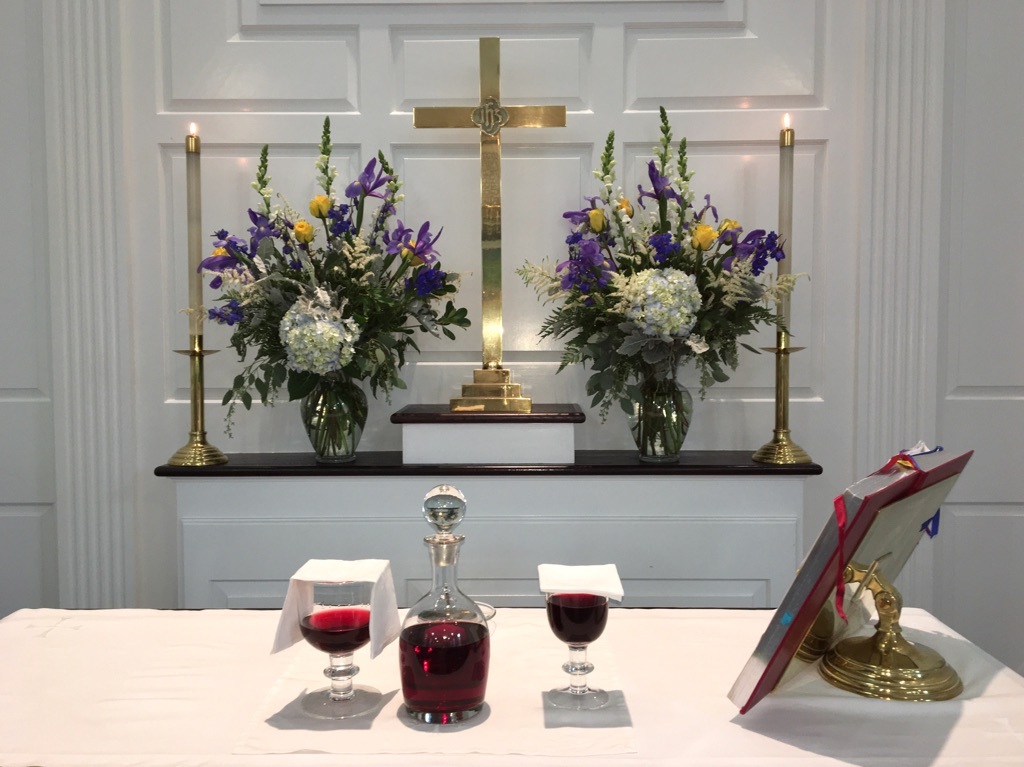
“Who do you say that I am?” That’s the question Jesus was ultimately driving toward when He started by asking His disciples, “Who do people say that I am?” If Jesus lived today, He might have an Instagram account, but He wouldn’t care how many likes He got on His feed. If He really cared what the word on the street was, it was only as it related to people coming to faith in Him, being gathered into His flock, coming within His saving embrace, recognizing Him and being drawn to Him as the incarnation of the Father’s love and mercy.
The setting for this Gospel story is really interesting and very important: Caesarea Philippi. Remember Herod the Great, whom Matthew tells us ordered the slaughter of the innocents following the Christ Child’s birth? He was not a great humanitarian but he was a great builder. He not only built the temple in Jerusalem but also a temple honoring Caesar Augustus, in an area that came to be called Caesarea. That’s ironic, building a temple to God and a temple to Caesar Augustus, who had deified himself (as if saying it made it so….). ‘Seems like a rather huge violation of the 1st commandment: “I am the LORD your God, you shall have no other gods besides me.” By the way, Caesar Augustus less-than-humbly gave himself the Latin title “Divi Filius”: Son of the Divine – so when Simon Peter addresses Jesus as “Messiah, Son of the living God,” Caesar and his minions would definitely hear that as competition and maybe even sedition.
Not only was Caesarea Philippi an homage to the Roman emperor (and Philip, Herod Antipas’ brother, who tacked his name onto Caesar’s, making it Caesarea Philippi): it was a pagan pilgrimage destination. Before its name change, the place was called Panias, in honor of the Greek god Pan, whose birthplace was said to be a cave there. You can probably picture Pan from mythology books – a bearded man with goat’s legs and hooves, goat’s horns and pointed ears, playing a multi-pipe pan flute. He was bawdy to the extreme, and sometimes depicted with bunches of grapes like Bacchus, maybe suggesting how uninhibited his behavior was – and that of his followers, too, to the point that “red light district” wouldn’t be too harsh a description of the sacred grotto dedicated to Pan, attracting droves of worshipers. There was a spring in that cave, believed to be the head waters of the Jordan River. In Greek and Roman mythology the fertility gods, including Pan, took the winter off, which is why the earth lays fallow. The people believed the fertility gods, like in the myth of Demeter and Persephone, wintered in the underworld, and the River Styx was their highway to get there. They believed the opening to Pan’s cave was an entry, a portal to the underworld – hence Jesus’ reference to “the gates of Hades” (Matt. 16:18) that will not prevail against the church!
Another fertility god was Ba’al, whom we hear about a lot in Hebrew Scripture, and to whom 14 temples were dedicated in Caesarea Philippi alone. Bottom line, there were lots of possible gods in whom to believe in the Roman Empire and in 1st century Palestine. Their images, sanctuaries, devotees were everywhere in Caesarea Philippi. So when Jesus asks, “Who do people say that I am?” “Who do you say that I am?” in that neighborhood, it’s clear that the field is crowded. And when Peter says, “You are the Messiah, the Son of the living God,” that’s in contrast to all those other false gods in whom many placed their dearest hopes and gave their heartfelt allegiance.
In whom will the disciples place their dearest hopes? To whom will they give their heartfelt allegiance? In the Fourth Gospel there’s no mention of Jesus going to Caesarea Philippi with the disciples and asking them, “Who do you say that I am?” Instead, after He multiplies loaves and fishes and tells the disciples, “Very truly, I tell you, unless you eat the flesh of the Son of Man and drink his blood, you have no life in you” (John 6:53b), many of the disciples balk and leave. Jesus then asks the twelve:
“Do you also wish to go away?” Simon Peter answered him, “Lord, to whom can we go? You have the words of eternal life. We have come to believe and know that you are the Holy One of God.” (John 6:67-69)
Peter is the group’s self-appointed spokesperson and on behalf of all he announces,“We’re sticking with you, Lord!”
“We have come to believe and know that you are the Holy One of God.” Is there a difference between believing that Jesus is Messiah, the Son of the living God, the Holy One of God, and knowing it?
For me, believing is head knowledge and knowing is heart knowledge. It’s like that in Hebrew: know is an intimate verb. For instance, David “knew” Bathsheba and she became pregnant. The night of Jesus’ arrest and trial, Simon Peter denied “knowing” Jesus 3 times before the rooster crowed, and it didn’t just mean he’d never heard of Him. In a sense it meant that even if Jesus were “known” to Simon Peter, Jesus and His fate were unimportant to him – Jesus of Nazareth was of no consequence to him.
Jesus is “known” to us, but is He also important to us? Who do we say Jesus is?? When questions like that show up in Scripture, they’re directed not only to the first disciples then, but also to us current disciples now. I think most of us sign on to Jesus being God’s Son. If we get that far, it’s not a leap to believe also that Jesus is our Savior. Savior was one of Caesar’s titles, too, from Julius Caesar all the way down to Hadrian. The idea was that the Roman emperor saved the nation from war by keeping the peace. (Remember the Pax Romana? It took an enormous army, many legions of Roman soldiers, thousands of centurions with 100 men under each of them, to keep that “peace.” In the Christmas Proclamation we hear how:
|
… in the forty-second year of the reign of Caesar Augustus, when the whole world was at peace, in the sixth age of the world, Jesus Christ, eternal God, and Son of the eternal Father, desiring to sanctify the world by His most merciful coming, having been conceived of the Holy Spirit, and nine months having elapsed since His conception, is born in Bethlehem of Judah, having been born of the Virgin Mary. |
|
| The Nativity of Our Lord Jesus Christ according to the flesh. | |
| Other than the Good Shepherd, my favorite title for Jesus is Lord. In the early days of the Christian persecutions, a Christian would be arrested and then commanded to burn incense before an image of Caesar and make the pronouncement, “Caesar is Lord.” Refusal to do so resulted in torture and often execution. The earliest Christian creed, long before the Apostles Creed or the Nicene Creed, was 3 words: “Jesus is Lord.” Substituting Caesar’s name for that of Jesus was so abhorrent that people chose being thrown to the lions rather than uttering those words, that blasphemy. There always have been and always will be modern-day Caesars who deify themselves and demand allegiance, seeking empire rather than the kingdom of God. We must reject “Caesar is Lord” as antithetical to “Jesus is Lord.” | |
We have no problem confessing with our lips, “Jesus is Lord.” When He asks us, “Who do you say that I am?” we can easily respond along with Peter, “You are the Messiah, the Son of the living God.” But honestly: do we claim Him as Lord on the weekend and serve other gods during the week? Like the fertility gods supposedly taking a vacation during the winter, do we take a faith vacation during the week? Do we both call on Jesus as Lord in worship and honor Him as Lord beyond this sanctuary? Are we intent on obeying those 2 greatest commandments: love God above all else and our neighbors as ourselves? Do we realize that any other shiny thing that distracts and lures us, any other “god” that requires only what we’re willing to give, is an idol? The counterpart to “Who do you say that I am?” is “Whom do you serve?” Our Lord Himself was the Suffering Servant, not an imperial wannabe. As we read in Philippians 2, Jesus,
6 …though he existed in the form of God,
did not regard equality with God
as something to be grasped,
7 but emptied himself,
taking the form of a slave,
assuming human likeness.
And being found in appearance as a human,
8 he humbled himself
and became obedient to the point of death—
even death on a cross.
9 Therefore God exalted him even more highly
and gave him the name
that is above every other name,
10 so that at the name given to Jesus
every knee should bend,
in heaven and on earth and under the earth,
11 and every tongue should confess
that Jesus Christ is Lord,
to the glory of God the Father.
Amen
Pastor Mary Virginia Farnham

-
Location