Feast of St. Francis of Assisi

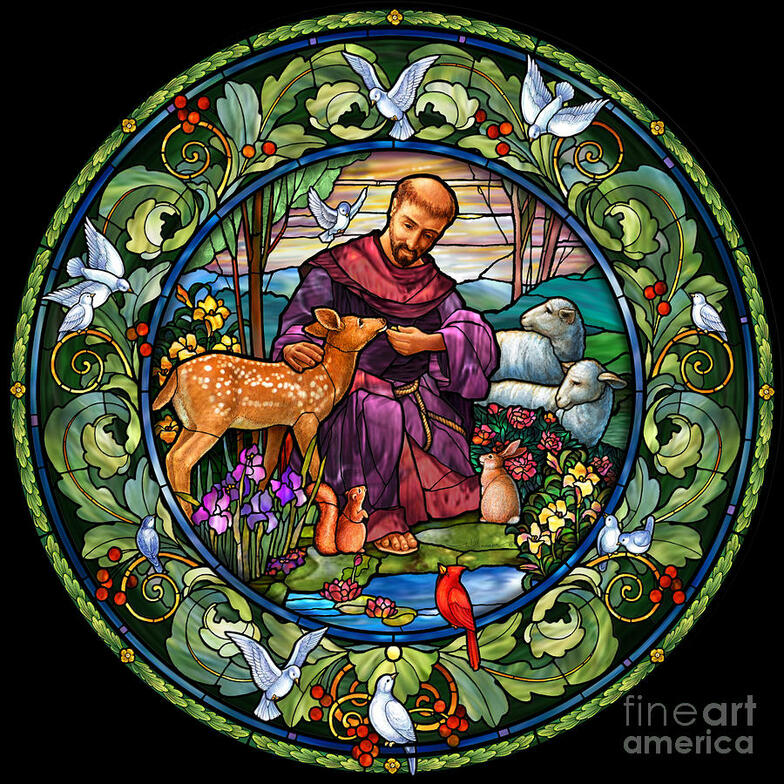
If I say, “St. Francis,” most people immediately think of Francis of Assisi. I looked up how many saints are named Francis (either spelled with an i or an e). I learned there are 88, according to one source! They include Francis Xavier, great missionary and co-founder of the Jesuit order, Francis de Sales who wrote the beautiful spiritual classic, Introduction to the Devout Life, and Frances Cabrini, the first American canonized by the Roman Catholic Church, a native of Italy, naturalized U.S. citizen, patron saint of immigrants, hospital administrators, lost causes and orphans. Among all the male and female St. Francises/St. Franceses, the one who always rises to the top like cream is Francis of Assisi, most famous son of a beautiful hill town in central Italy, which I know some of you have visited.
I spent 6 weeks in Europe the summer between my junior and senior year of college. It was a whirlwind “If it’s Tuesday, this must be Belgium” kind of tour, which I fully enjoyed. We only had a couple days in Rome, but I split off on one of them to take the train alone to Assisi. Back in 8th grade I’d chosen “Francis” as my Confirmation name because I was so fascinated by his story; now I wanted to see his home. I didn’t speak Italian so was nervous about taking the train to the right destination and making it back again to rejoin my group, but .by God’s grace and the fact that so many Italians speak English, I made it safely, round-trip. In the Church of Santa Chiara, Saint Clare, I knelt in front of the same cross Francis had knelt before when he heard the Lord say, “Francis, rebuild my church.”
Many of you know the story. Francis was born in 1181 or 1182. As a young person from a wealthy family he loved the party life; he was the life of the party. He was a romantic, imagining himself as a troubadour winning his lady’s heart by singing at her window. He also imagined himself as a knight, charging off to battle and returning victorious. When his city state, Assisi, went to war with a neighboring city state, Perugia, he signed up to fight. He was captured, became a POW, languished in a dungeon until he was ransomed. Francis returned to Assisi quite ill. All of a sudden he had plenty of time to think, to reflect on his life. The Holy Spirit sowed seeds of change during Francis’ imprisonment and extended recuperation.
Well enough to be out and about again, Francis stopped into a little church one day. It was called San Damiano, and it was in quite a state of disrepair. Francis didn’t care; he just needed a quiet place to pray. As he knelt there, gazing at a crucifix, he heard Christ speak to him, quite clearly. The message was: “Francis, go and repair my house which is falling into ruin.” Francis took that literally: shore up the walls! Repair the roof! Fix the windows! (Knowing Francis, evicting the church mice probably was not part of the rehab plan.) He had willingness, talent and time, but no money for materials. So he went to his wealthy father’s cloth shop, took one of the most expensive bolts of fabric and sold it. His father was not amused and disowned him. The story is that Francis stood in the town square, disrobed, and announced that now he only had one Father, in heaven. From that point on he was basically homeless, penniless, and couldn’t have been happier.
On Feb. 24, 1209, when Francis was about 27, he worshiped and heard the same Gospel we just heard from Matt. 10 (10: 7-13).
As you go, proclaim the good news, ‘The kingdom of heaven has come near.’[a] 8 Cure the sick; raise the dead; cleanse those with a skin disease; cast out demons. You received without payment; give without payment. 9 Take no gold, or silver, or copper in your belts, 10 no bag for your journey, or two tunics, or sandals, or a staff, for laborers deserve their food.
He heard those words as God’s direct message to him and again, took them quite literally. So as he left the church building he took off his shoes, removed his outer cloak, left behind his staff and replaced his belt with a rope. Francis had no use for earthly wealth, only deep longing for treasure in heaven. He asked for and accepted alms, charitable donations, on behalf of the poor. He was now counted among the poor. His nickname was the Povarello, the Little Poor Man. He enthusiastically and often spoke of being married to Lady Poverty, whom he loved dearly. Among the Gospel values of which Francis still reminds the church are solidarity with the poor and simplicity of life: “Live simply, so others may simply live.”
Francis had a charismatic personality, which may account why some say he is the most popular saint of all time. People were attracted to him like bees to honey: he was joy-filled, kind, funny, sincere, humble, real. His peace-loving personality may explain how he managed to visit the Muslim Sultan of Egypt during a Crusade and come away alive. Francis bravely ventured into enemy territory to meet the Sultan, intending to convert him. Not surprisingly, the Sultan didn’t want to become a Christian, but he and Francis enjoyed many hours of conversation. Then Francis was given safe passage back home again.
In the first 10 years of his new existence married to Lady Poverty, serving the poor, preaching the love of God to the people and to the birds, Francis attracted 5,000 men to join what has come to be called the Order of Friars Minor. Administration was not among Francis’ spiritual gifts, so as the community mushroomed and conflicts multiplied, he became unhappy. His health was also failing (he didn’t treat Sister Body well….) and he was becoming blind. Finally he turned over the reins of administration to others. In the last years of his life he enjoyed time and solitude for the prayer his mystic soul so loved. The only way he could imagine feeling closer to Jesus than he already did was to experience the wounds of his crucifixion. Francis did indeed develop wounds on his hands, feet and side, like marks left by nails and spear. We can’t explain this phenomenon, called the stigmata. It’s visible in many pictures of Francis.
Faith-filled stewardship, solidarity with the poor, simplicity, peacemaking, love of Jesus, love of neighbor, love of creation: these are Gospel values Francis lived and preached. He summed it all up in this advice: “Preach the Gospel. If necessary, use words.”
I talk about St. Francis every year around this time, because October 4 is his special day on the calendar, his heavenly birthday, marking his death. He died in the year 1226 so this weekend is the 800th anniversary of his death. We’ll bless the animals after 10:30 worship this weekend, because one of the best-known parts of Francis’ life is his love of animals. Stories have come down to us about how he preached to the birds, asking them to be quiet during his outdoor preaching so the humans could hear, and how they flew away in a cross formation afterwards; how he preached to the fish; how he tamed the man-eating wolf of Gubbio, whom Francis convinced to stop eating people and start eating whatever the local residents fed him.
Since we talk about Francis of Assisi every year, and he’s so popular and well-known, I’m thinking everyone is knowledgeable enough to help our confirmands and 3rd through 6th graders fill out their sermon notes tonight J.
- Where did St. Francis live?
- ________ the Jersey Shore; b. _________ Germany
- ________ Italy; d. ________ Australia
- When was he born?
- ________ 1900’s (when your parents were probably born)
- ________ 1700’s (when our country was born)
- ________ 1100’s (when Crusades happened and many cathedrals were built)
- What sad thing happened when Francis became a knight and went to war? ___________________________________________________________________________________
- Francis was praying one day in a little church (San Damiano) when he heard a Voice that seemed to come from the crucifix. The voice told him to:
- ________ put more money in the offering plate.
- ________ repair the church.
- ________ take off his muddy shoes.
- ________ read his Bible more.
- Francis never married anybody, but he did talk a lot about being wed (married) to Lady _______________.
- Francis owned nothing, dressed simply, and spent all his energy preaching about God’s love and helping the poor. His nickname was the Povarello which means “the ______________ ______________ man.”
- Francis visited the Sultan of Egypt. He wanted to convert him to Christianity from what religion? __________________
- Francis’ best advice is: “Preach the Gospel. If necessary, use _________________.”
St. Francis, lover of Christ, lover of the poor, was also a poet and a singer. He wrote the Canticle of the Sun pretty much on his death bed. It became a beautiful hymn we’re singing this weekend, “All Creatures, Worship God Most High” (ELW 835) A prayer attributed to St. Francis is inscribed on my alb. It is probably familiar to many of you, and it begins, “Lord, make me an instrument of your peace.” It was a favorite of Dwight David Eisenhower, 5 star general, Supreme Commander of the Allied Expeditionary Force during WW II, and our 34th U.S. president. “Blessed are the peacemakers, for they will be called children of God.” (Matthew 5:9) Blessed are those who take the Gospel literally, shining with the light of Christ, seeing and serving Christ in those in need, and honoring the Creator by caring faithfully for the creation. Amen Pastor Mary Virginia Farnham

-
Location