The Holy Trinity: “Third Place, Holy Space”

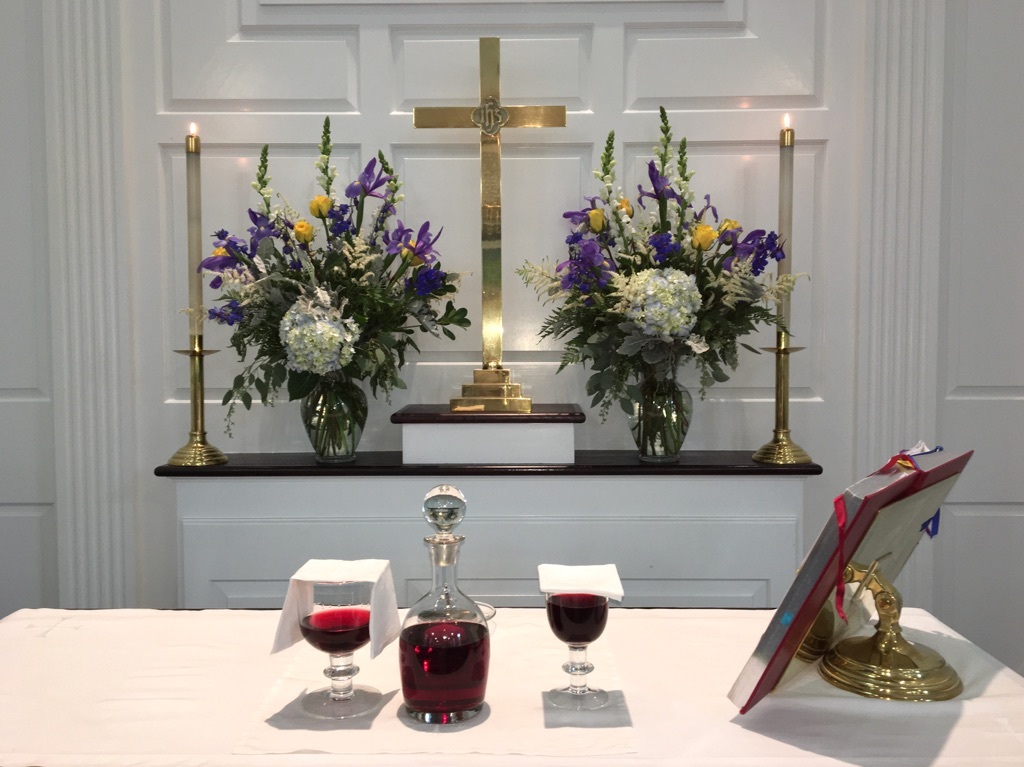
Have you heard of “third places”? Not third base; third place! It’s a phrase coined by American sociologist Ray Oldenberg. The first place is home; the second place is school or work; the third place is where you go to experience community, without having to pay or buy something. Here’s one explanation I found:
At a third place, you might go to hangout with your friends, you might run into acquaintances by chance, or you might meet people you have never encountered before. It is a meeting ground to build relationships with others outside of home or work.1
‘Sounds a lot like church, doesn’t it?? The article I read was from the University of Chicago, though, so church didn’t come up. Bars, pubs, coffee shops, libraries, parks, did. The author talks about Americans loving to gather around food and drink. [Gesture toward altar.] That also sounds familiar, whether we’re talking about Holy Communion in here or coffee hour out there [Fellowship Hall]. The writer continues:
For Americans, third places are where we can both affirm our own identities and build empathy for identities different from our own... When we connect with members of our community at third places, we can find people who share… [various] identities with us. It can be incredibly affirming to find people who have identities similar to our own in our own community... At the same time, third places allow for a space to meet people entirely different from us. We can meet people from different cultures, backgrounds, and life experiences, which encourages us to empathize with people of different identities. We can learn about the experiences of those different from us and use our resources to support our community, standing in solidarity no matter if we share an identity or not. Third places make us feel as if we belong to a society bigger than ourselves.2
Our Holy Trinity community started out a lot less diverse than we are now. German immigrants and Norwegian fishermen, probably all cradle Lutherans, made up a significant portion of Holy Trinity’s membership, way back when. There’s a plaque in the narthex with the names of the fifteen charter members. Last names: Andersen, Carlson, Hansen, Mueller, Oehler, Olsen, Schweickart, Willinger. Not exactly a league of nations J. When they came to this country, I’m guessing church was their most important community outside of the home. Church rituals helped to ground their existence. Something’s a ritual if it’s always done the same way. Sports teams and individuals have game day rituals. Schools have field day and graduation rituals. Clubs and Scouts have initiation rituals. Rituals ground us. The sameness gives us a sense of security. The shared bonds give us a sense of belonging.
Many people today lack a sense of belonging. They feel adrift in a sea of anonymity, surrounded by plenty of people but few friends or family. A column in the paper, “The Antidote to a Lonely Life of Screens,”3 seems very apropos to our Feast of the Holy Trinity this weekend. The writer comments on the plunging frequency of some traditional rituals like baptisms, marriages, even funerals. (Did you know: only a third of the people who die these days are buried?) But Bruce Feiler also documents a surge in the number of new rituals to which people turn to counteract what could easily be an isolated existence, including reveal parties, sound baths, NICU graduations, mastectomy circles, and honor walks. I’d seen an honor walk on TV but didn’t know it’s an actual thing. When a person suffers brain death and organs are being donated, the family can push the patient on the gurney to the operating room where the organs will be harvested. Hospital staff line the halls as an honor guard “in tribute to the gift being given.”4 Such community affirmation of an individual’s and a family’s altruism in sharing the gift of life in the wake of death. Such meaningful accompaniment in a time of profound grief. Those are very good things. When I was a hospital chaplain 35 plus years ago, organ donation was very much a sacred act, but also a very private thing. Families signed a paper and left the hospital. What a difference community acknowledgement must make.
One of our church friends recently told me about another ritual event, another third space I’d never heard of: a silent book club! It’s a gathering of people who want to quietly read their book in the company of others, but after they’ve socialized first. Each one of these book club meetings is like “mini-bookworm convention meets silent retreat.” Creative! Clever!
Where there is community-of-the-heart, where there are life-giving third spaces, where there are rituals that renew our spirits, soften our sorrows, and spread our joy, there is the Holy Trinity. The pediment over our chancel is carved with triangles and trios of interlocking rings, representing Trinity. The only stained glass in our sanctuary represents the three Persons of the Holy Trinity: the Creator’s hand extended in blessing signifies the Father, the letters IHS stand for the first 3 letters of Jesus’ name in Greek, the dove symbolizes the Holy Spirit. If we were called St. Patrick’s instead of Holy Trinity we’d probably have a few shamrocks sprinkled into the mix, since Patrick used the 3-leaves-in-1-plant to teach about 3-Persons-in-one-God. I’m more of a gardener than a mathematician, so I’d choose a shamrock over geometric symbols any day J to represent Trinity. But actually all of those possibilities fall short. I think a video would do the Trinity more justice than a static image: specifically, a video of 3 people dancing!
Perichoresis is the beautiful, fancy name for the relationship among the 3 Persons of the Trinity: Father, Son and Holy Spirit; Creator, Redeemer and Sanctifier. Divine Dance is as good a translation as any for that unusual word. The 3 Persons are distinct yet they occupy the same space. They dwell in each other. They move in harmony. They act in unity. Our Christian community is meant to reflect that harmony and unity. Even if our faith family weren’t named “Holy Trinity,” we’d be meant to reflect the peace and beauty of the three-fold God who has claimed and named us in Holy Baptism, when we were washed in living water “in the name of the Father and of the Son and of the Holy Spirit.”
In “The Antidote to a Lonely Life of Screens,” rituals are described as:
… the glue that holds society together, the first human algorithm. Paleoanthropologists have identified what could be ritual gathering places from 300,000 years ago where our earliest ancestors honored their dead. In pretty much every culture ever studied, humans marked moments of uncertainty and joy with collective, ceremonial life celebrations. Rituals calm us when we’re stressed, synchronize our heartbeats when we’re scared and align us to others when we celebrate or mourn together. They strengthen families, neighborhoods and groups of all kinds.5
Baptism is the ritual of initiation in the Body of Christ. Holy Communion is the ritual family meal. Our gathering for these rituals in this third place of church gladdens and encourages us. St. Paul says: many members, one Body. We are separate tiles that fit together in a beautiful mosaic. We are many threads woven into a single tapestry. Some days we see only the back of the tapestry, without a discernable pattern, and depending on the weaver’s style, we see just a maelstrom of thread ends or a disciplined parade of knots. Other days the Spirit enables us to see the front of the work of art, filling us with awe at what God can do with such humble raw materials as we are.
Our Holy Trinity faith family has particular rituals related to outdoor worship, the Blessing of the Animals, Good Morning, Good Friday, Break-the-Fast reception, college care package mail-out, bread delivery to visitors. But none of our rituals are or ever will be as important as Baptism and Holy Communion. For us these are the incomparable means of grace, right up there with the Word of God.
Bruce Feiler, the author of the ritual article, warns:
As artificial intelligence pushes deeper into lovebots, deathbots and godbots, the pressure will mount on all of us to build fresh pathways to belonging, togetherness and shared meaning. Increasingly, we face a choice: it’s virtual or ritual, URL or IRL [in real life]. Ritual may not be our last hope, but it may be our best hope – one gathering at a time.
We’re glad to build fresh pathways, but will also cling to the tried and true, as Jeremiah 6:16 advises:
Thus says the Lord:
Stand at the crossroads and look,
and ask for the ancient paths,
where the good way lies; and walk in it,
and find rest for your souls.
In the name of the Father and of the Son and of the Holy Spirit. Amen
1Madeleine Roberts-Gamin, “Third Places – What Are They and Why Are They Important to American Culture?” (The U. of Chicago English Language Institute, Nov. 1, 2023).
2Ibid.
3Bruce Feiler, “The Antidote to a Lonely Life of Screens” (New York Times, May 25, 2026), p. .
4Ibid.
5Madeleine Roberts-Gamin, op. cit.
Pastor Mary Virginia Farnham

-
Location